The kinnow is Pakistan's winter citrus and, by weight, its biggest fruit crop: around 2.7 million tonnes in the 2025-26 season by the exporters' own estimate, with some growers reporting a record above 3 million, and between 80 and 90 per cent of it from one district, Sargodha. It is in season from late November to March, it is cheapest and sweetest in January, and it is not a native fruit at all: it was bred in a California experiment station, released in 1935, and found its real home in the Punjab canal colonies a decade later.
This guide covers where the kinnow came from, when and where it grows, what the export trade does with it, what is in one, why it has so many seeds, how to tell it from a malta, and five ways to use it, one of which works in July.
Where the kinnow came from
The kinnow is a hybrid of two mandarin-type citruses, King and Willow Leaf, crossed by the plant breeder Howard B. Frost at the University of California's Citrus Experiment Station in Riverside in 1915 and released for commercial growing in 1935. It never became important in California. Budwood reached the Punjab Agricultural College at Lyallpur, today's Faisalabad, in the 1940s, and the tree turned out to like the Punjab plains far more than it liked Riverside: hot summers to build sugar, cool dry winters to colour the skin and sharpen the acid, and canal water on demand.
The fruit that resulted is easy to recognise. Flattened, deep orange, with a thin, loose skin that peels by hand, segments that come apart cleanly, a sweet-tart juice with more character than a sweet orange, and a great many seeds, which the fruit inherited from both parents. Fifteen to thirty seeds in a single kinnow is normal; it is the one thing everyone would change.
When it is in season
Kinnow trees flower in spring and the fruit sits on the tree through the summer, colouring with the first cool nights of November. Picking starts in late November, and the season has a shape:
- December to February is the heart of it. The fruit is fully coloured, the sugar is up, and the mandis are flooded, so this is when a dozen costs least.
- March and April bring the late fruit, sweeter and softer, from orchards that held it on the tree; it keeps less well.
- May is the end. In warm autumns the whole calendar slips a few weeks later, and there have been seasons when the fruit was not properly ripe until the end of December.
There is no summer kinnow. Cold storage carries some fruit a few weeks past the season, at a price, and then it is gone until November.
Where it grows
Sargodha, in central Punjab, is the kinnow district the way Multan is the mango district, and more so: the growers' associations put 80 per cent of the national crop there, the provincial government has said 90. The orchards run through Bhalwal, Kot Momin, Sillanwali and Sahiwal tehsil of Sargodha, with the rest of the crop in neighbouring Faisalabad, Toba Tek Singh, Jhang and Mandi Bahauddin. Drive the Sargodha road in January and the fruit is on both sides for an hour.
The district has a Citrus Research Institute, a processing industry of waxing and grading plants that work through the winter nights, and a juice trade that supplies the "fresh kinnow juice" carts in every city of the country.
The export trade
Kinnow is Pakistan's biggest fruit export by volume. The exporters' association shipped 250,000 tonnes in the 2024-25 season, worth about 95 million dollars, and set a 300,000-tonne target for 2025-26; five years ago the figure was 550,000 tonnes, before Russia, which was the largest market, turned into a loss-maker. The fruit now goes mainly to the Gulf, Afghanistan, Indonesia, the Philippines, Sri Lanka and Central Asia. The independent trade press thinks the country could ship twice what it does, if freight and the fruit's seeds and short shelf life did not count against it. For the shopper, the export season is good news: the best-graded fruit leaves the country, but there is so much of it that January prices stay low anyway.
What is in a kinnow
Per 100 g of fresh fruit, from the USDA entry for mandarins: about 53 kcal, 27 mg of vitamin C, 1.8 g of fibre, 11 g of the fruit's own sugars and 166 mg of potassium. A kinnow weighs about 100 to 150 g, so two of them cover a day's vitamin C, which is the whole case for eating them through a Pakistani winter.
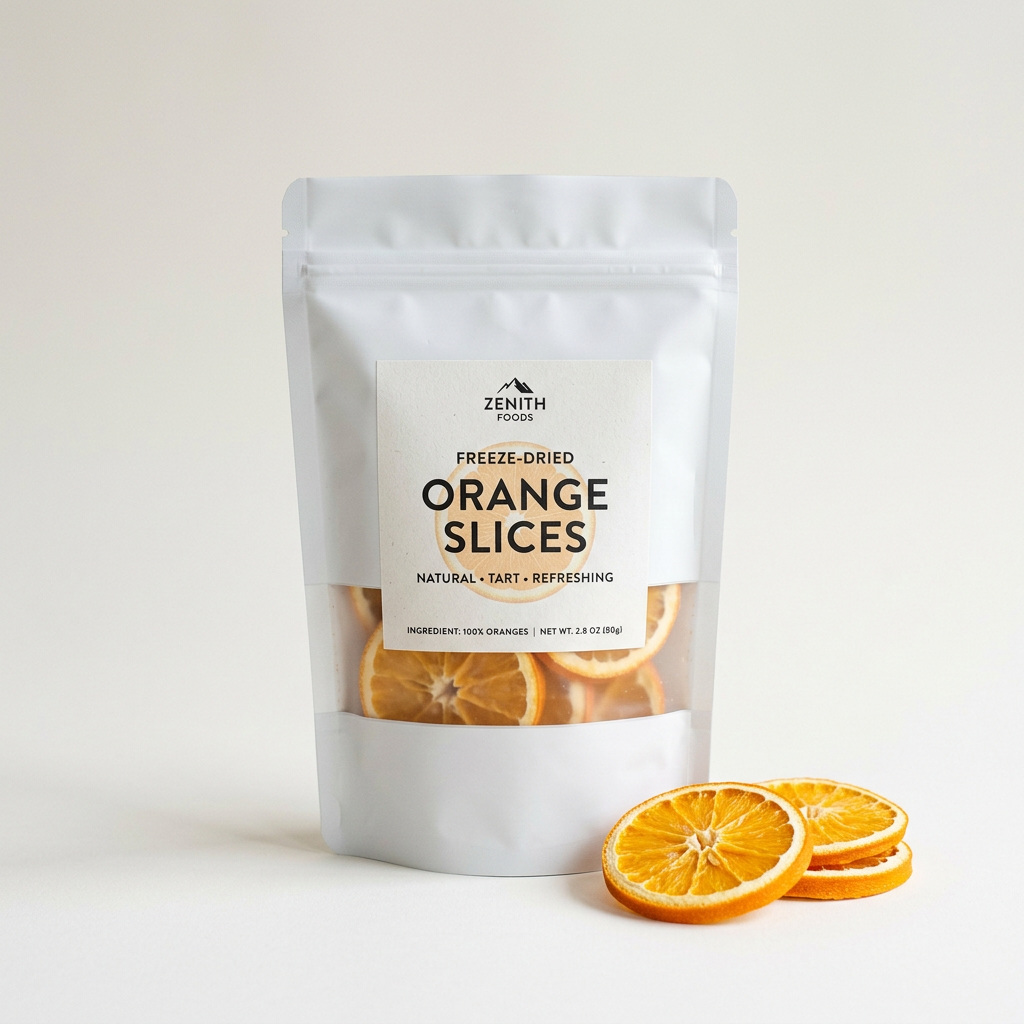
Our freeze-dried kinnow wheels are cut across the whole fruit with the peel on, so each wheel is a full cross-section of a Sargodha kinnow, and dried without heat. Typical values per 100 g: 325 kcal, 50 g of the fruit's own sugars, 13 g of fibre and 510 mg of vitamin C, the vitamin C surviving because nothing is ever heated. The rind carries the bitter edge and most of the aroma. Treat 25 g as about two fruits' worth.
Kinnow or malta?
Both are sold as "orange" and they are not the same fruit. The kinnow is a mandarin hybrid: flattened, thin loose skin, easy segments, sweet-tart, seedy. The malta is a sweet orange: rounder, thick skin that wants a knife, milder juice, far fewer seeds. Kinnow is for peeling and eating and for the sharp juice; malta is for the juicer and for anyone who wants a quieter flavour. If it peeled in one piece in your hand, it was a kinnow.
Choosing and keeping them
Buy fruit that is heavy for its size, with a skin that is firm and slightly glossy, and not a skin that has gone puffy and separated from the fruit, which means it is old. A kinnow keeps a week in a cool room and two or three in the fridge, and it goes dry rather than rotten, so eat the oldest first. Peel just before eating; the segments dry out within an hour of peeling.
Five ways to use it
- Peeled, with kala namak. The way most of Sargodha's crop is eaten. A pinch of black salt or chaat masala on a segment is the winter snack.
- Fresh juice. Two kinnows to a glass, seeds strained out. The carts charge for the labour, not the fruit.
- In a glass of water. Drop a freeze-dried wheel into cold water, iced tea or a mocktail and it rehydrates and flavours it in a few minutes, peel and all, which is what cafes use them for. No sugar, no syrup.
- The peel, dried. Strips of kinnow peel left on a plate for three days make a bitter-aromatic addition to chai, or ground into a powder for cakes. Wash the fruit first; most market kinnow is waxed.
- On a cake, or in July. Freeze-dried wheels do not weep on a cheesecake and do not exist as fresh fruit from May to November, which is the honest reason to keep a pouch: the kinnow wheels are Rs 1,280 for 100 g, start at Rs 690 for 50 g, and keep 12 months sealed.
The short version
Buy kinnow by the dozen from December to February, eat two a day, and do not expect to find one in August. All our pouches, the kinnow wheels and the five-fruit mix among them, come in 50 g, 100 g, 250 g and 500 g, delivered for Rs 299 to any city in Pakistan, free over Rs 4,000, with Cash on Delivery, and same-day in Lahore before 2pm.
Sources: origin from the University of California Riverside citrus variety collection; the 2025-26 crop, export volumes and markets from the exporters' association as reported by ProPakistani and FreshPlaza; Sargodha's share from provincial and growers' statements reported by Dawn; fresh-fruit nutrition from the USDA food database.